UNIJOS TETFUND CENTRE OF EXCELLENCE IN FOOD SECURITY CONCLUDES SHORT COURSE WITH BUSINESS PROPOSAL AND CERTIFICATE PRESENTATIONS
TETFUND CENTRE OF EXCELLENCE IN FOOD SECURITY UNIJOS CONCLUDES SHORT COURSE WITH BUSINESS PROPOSAL AND CERTIFICATE PRESENTATIONS
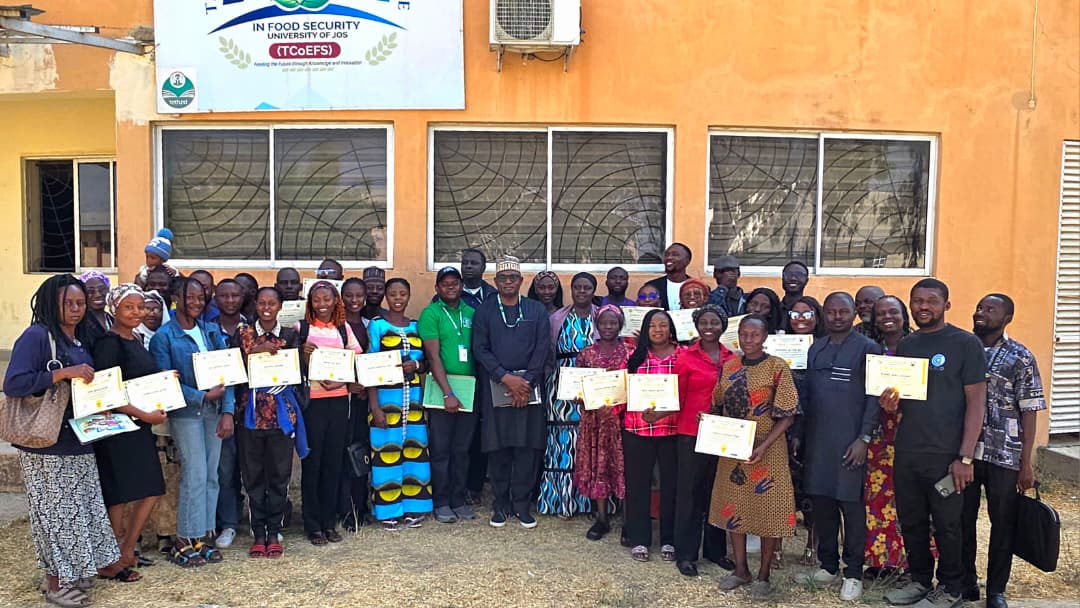
The first short course of the TETFund Centre of Excellence in Food Security under the leadership of the Director, Prof. Bitrus Dauda Bawa, ended in a ceremony with the presentation of business proposals by the participants and the award of certificates on March 6th, 2026.
The two-week long short course training on Post-Harvest Management of Fresh Produce was attended by over 50 participants made up of students and members of the public and was held in the TETFund big boardroom in the Naraguta campus of the University of Jos from 16th February to March 6th, 2026.
The short course, in collaboration with Ecofarms and Agro Services Limited, Jos, witnessed various trainers taking up different topics on how to reduce post-harvest losses in fruits and vegetables, improved handling, sorting, packaging and storage of fruits and vegetables, quality control and food safety, and value addition entrepreneurship.
The participants had hands-on and practical trainings on all the topics covered and there was a visit to Ecofarms and Agro Services located at the Miango Road junction, giving the participants a practical farm experience.
At the closing ceremony, the Director of the Centre, Prof. Bawa, thanked trainers and trainees and noted that the university curriculum is theoretically based and has limitations for employability skills. He stated that unlike in developed countries where practicals are prioritized over theory, most graduates there become functional in society more easily. He explained that the short course was designed to equip participants with functional education and that they can be self-employed as the skills learned in the short course put every participant ahead of other students.
He also noted that Ecofarms are driving precision agriculture practices in Nigeria. Prof. Bawa encouraged participants to remain active and keep in touch with the Center as there will be more advanced courses from the Center.
During the closing session, the four different groups made their final presentations of their learning experiences on the handling, sorting, packaging and storage of fruits and vegetables to make them market-ready. Group One presented a business plan on bell pepper to be produced all year round and processed for longer shelf life. Group Two presented a dried Irish potato business plan using dehydration. Group Three presented their business plan on mango and pineapple jam production, while Group Four’s business plan embodied processing services to mitigate post-harvest loss, ranging from mango to juices and tomatoes to paste.
Participants from other groups were allowed to ask questions, while clarifications were made with the facilitators. The Director also made constructive criticisms on how the business plans could be improved.
The highlight of the event was the presentation of certificates to all participants.
Speaking on the training, the Deputy Director (Research and Training) of the TETFund Centre of Excellence in Food Security, Prof. Uchele Okpanachi, described the programme as impressive but noted that there was still room for improvement.
According to him, the goals of the short course on post-harvest loss cannot be over emphasised as it aims to reduce post-harvest losses in fruits and vegetables, improve handling, storage and transportation practices, strengthen food safety and quality control, and increase the shelf life and market value of produce.
He affirmed that the short course met the core objectives of the TETFund Centre of Excellence in Food Security.
Also speaking, the Deputy Director (Innovation & Extension) and Thematic Head, Crop and Biotech, Dr. Kyenpia Deshi, said the training provided practical skills to reduce spoilage, increase shelf life and maintain nutritional value. She explained that such trainings empower farmers and stakeholders to minimise waste, enhance market value and ensure a safer and more consistent food supply, thereby enhancing food security.
She added that the participants are now more knowledgeable and better equipped to address issues related to post-harvest loss management.
Dr. Deshi further noted that the facilitators were well prepared and presented their sessions in clear and very practical ways.
On future plans, she stated that the Center hopes to improve on the lapses observed in the just concluded short course as feedback is obtained from participants in order to strengthen subsequent editions of the training programme.
The vote of thanks was delivered by Victor Anebi, a student from the Faculty of Agriculture, University of Jos. He thanked the Center for organising the training and appreciated the experiential learning opportunity provided to participants. According to him, the training will go a long way in developing their capacity, particularly in the area of post-harvest loss management.
By Jimme G. Matyek
Communication and Documentation Officer
- Log in to post comments